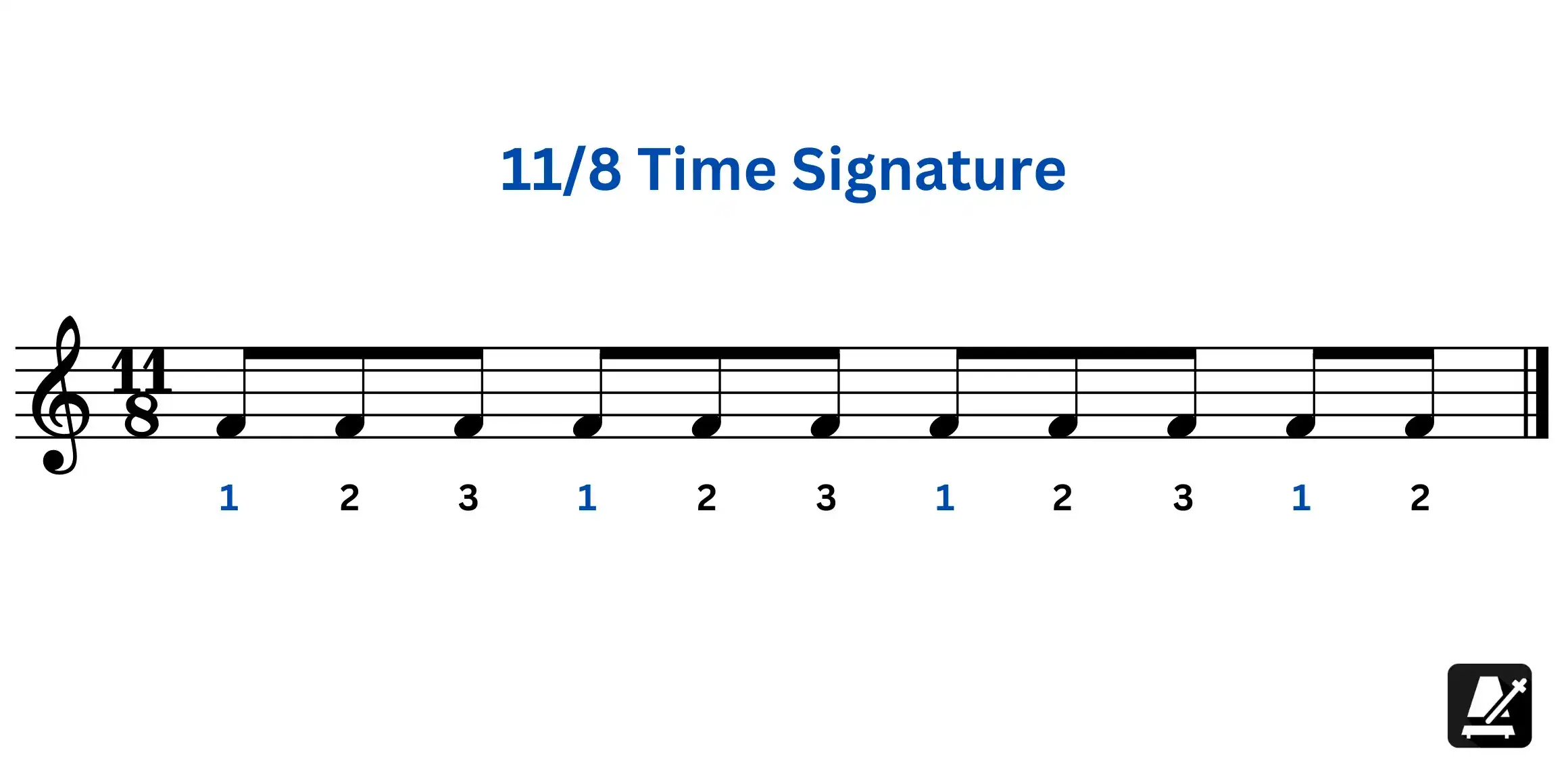
11/8 Time Signature Explained
11/8 means there are 11 eighth notes in each bar, and the eighth note is the beat unit. So one measure lasts for eleven 8th-note pulses.
In practice, 11/8 is usually organized into smaller groups (built from 2s and 3s) so the bar has a clear shape instead of feeling like a long count. Next, we’ll go through the most common groupings, show how to count them, and give you metronome audio to practice with.
How to count 11/8 time signature?
Instead of counting 1…11, 11/8 is usually counted as grouped numbers. You pick a grouping made from 2s and 3s, then restart the count at 1 for each group.
- Pick a grouping (made from 2s and 3s)
- Count each group from 1 again
- Feel the bar by locking onto the start of each group (those are your accents)
Below are five common 11/8 groupings, with counting and audio for each.
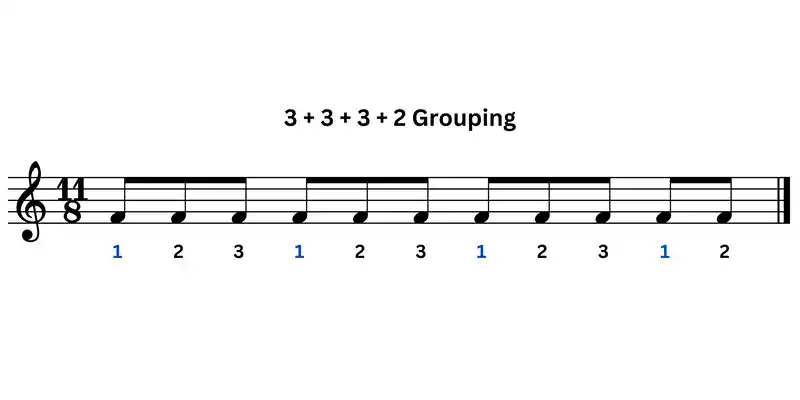
3 + 3 + 3 + 2 grouping
Think: ONE-two-three ONE-two-three ONE-two-three ONE-two
Accents usually land on the start of each group.
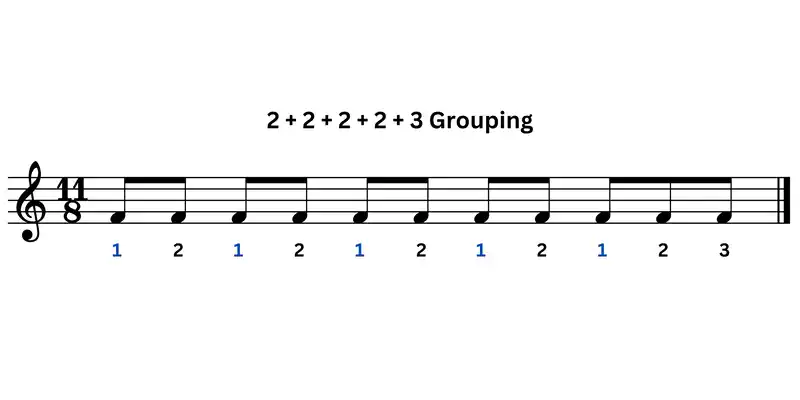
2 + 2 + 2 + 2 + 3 grouping
Think: ONE-two ONE-two ONE-two ONE-two ONE-two-three
This one often feels very “walkable” because it has four short groups before the final 3.
You might also see this described as “4+4+3”. In counting terms, that’s really (2+2) + (2+2) + 3 — treating “4” as one big beat often makes the accents drift.
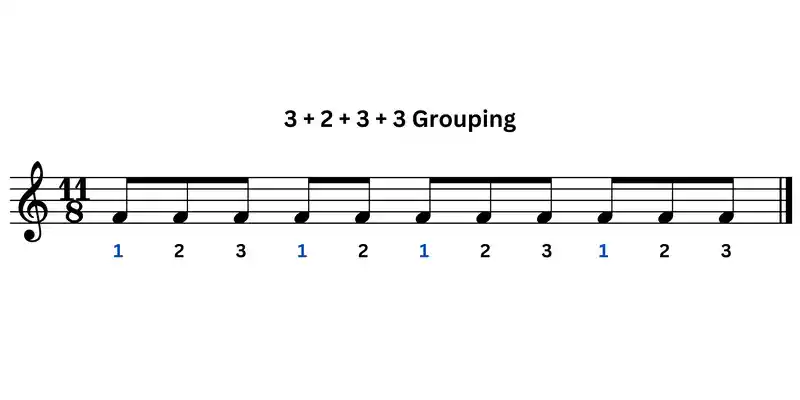
3 + 2 + 3 + 3 grouping
Think: ONE-two-three ONE-two ONE-two-three ONE-two-three
A common mistake here is to rush the 1-2 group. Keep it the correct width.
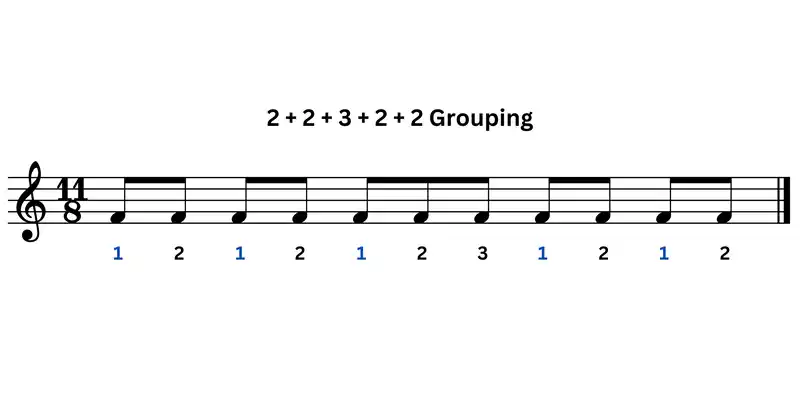
2 + 2 + 3 + 2 + 2 grouping
Think: ONE-two ONE-two ONE-two-three ONE-two ONE-two
This grouping is great if you want the “3” to feel like a single moment in the middle of the bar.
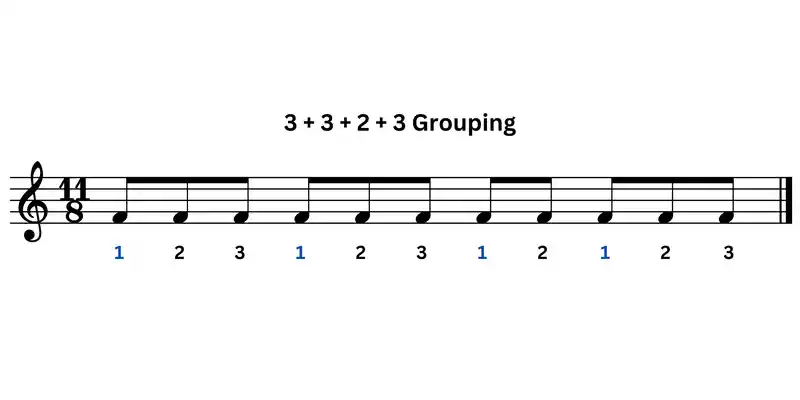
3 + 3 + 2 + 3 grouping
Think: ONE-two-three ONE-two-three ONE-two ONE-two-three
This one often feels like it “leans” into the end of the bar because it finishes with a 3.
If you drift, simplify the task: keep the grouping and clap only the group starts until it feels stable again.
How to find the grouping in a song
If a song is written in 11/8, the main question is usually: which 11/8 grouping is it using? Here are a few reliable ways to figure that out.
- Look at the beaming in the notation. In 11/8, beaming often matches the grouping (for example, 3+3+2+3).
- Listen for where the bar “resets”. The strongest hits often land on the group starts.
- If there’s a drum groove, the kick/snare pattern usually gives away the group starts.
- Try clapping only the group starts for one grouping (like 3+3+3+2). If it keeps feeling stable over a few bars, you probably found the right one.
Once you know the grouping, practice gets much easier because you’re repeating a clear pattern, not counting to 11 every bar.
Practice 11/8 with a metronome
Open the 11/8 metronome and choose the accent option that matches your grouping.
Exercise 1: clap only the group starts
Pick one grouping first and stay with it.
- Set the metronome to 11/8.
- Choose one accent option (one grouping).
- Clap only on the accented clicks (the group starts).
- Do this for 60 seconds without drifting.
This is the fastest way to stop 11/8 from feeling like “too many clicks”.
Exercise 2: speak the numbers on every click, clap only group starts
This locks the small pulse (eighth notes) to the big shape (the grouping).
- Keep the same grouping and tempo.
- On every click, say the numbers of the grouping (don’t speed up):
- example:
1-2-3 1-2-3 1-2-3 1-2
- example:
- At the same time, clap only on the accented clicks (the group starts).
If it’s too much at first, do it in two passes: say the numbers for 20 seconds without clapping, then add the claps.
Exercise 3: practice the pattern from your song
Match your practice to the grouping your piece actually uses.
- Keep the metronome on your song’s grouping.
- First pass: play or tap only on the group starts.
- Second pass: add the remaining notes, but keep the group starts clearly felt.
Common mistakes
- Counting straight to eleven — Switch to grouped counting (start from 1 again at each group).
- Losing the group starts — Strip it back and clap only on the accents for 30–60 seconds.
- Rushing the short (2) groups — Slow down and make the
1-2groups feel just as wide as they should. - Practicing too fast too early — If you can’t speak the grouped numbers evenly, the tempo is too high.