5/8 Time Signature Explained
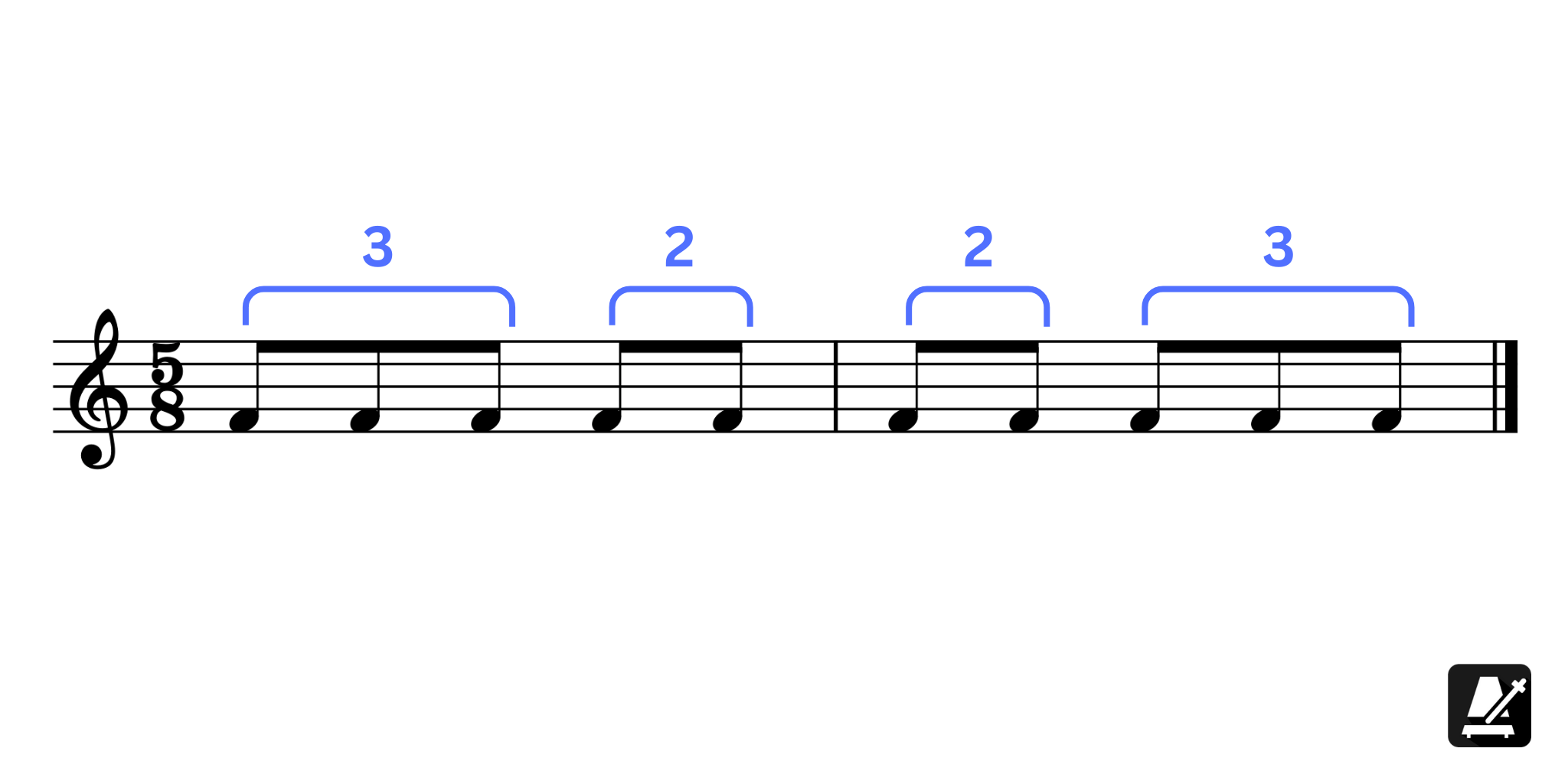
If 5/8 feels confusing at first, it’s usually because you’re trying to count five equal beats instead of hearing the bar as two groups. In practice, 5/8 is usually felt as 3+2 or 2+3.
In this post we’ll make those two groupings feel steady, learn counting methods that still work at tempo, and run a short practice plan you can do with a metronome.
How to count 5/8 time signature?
In 5/8, the beat unit is the eighth note. But in performance and practice, you rarely feel five identical pulses. You feel two larger pulses made of 3 and 2.
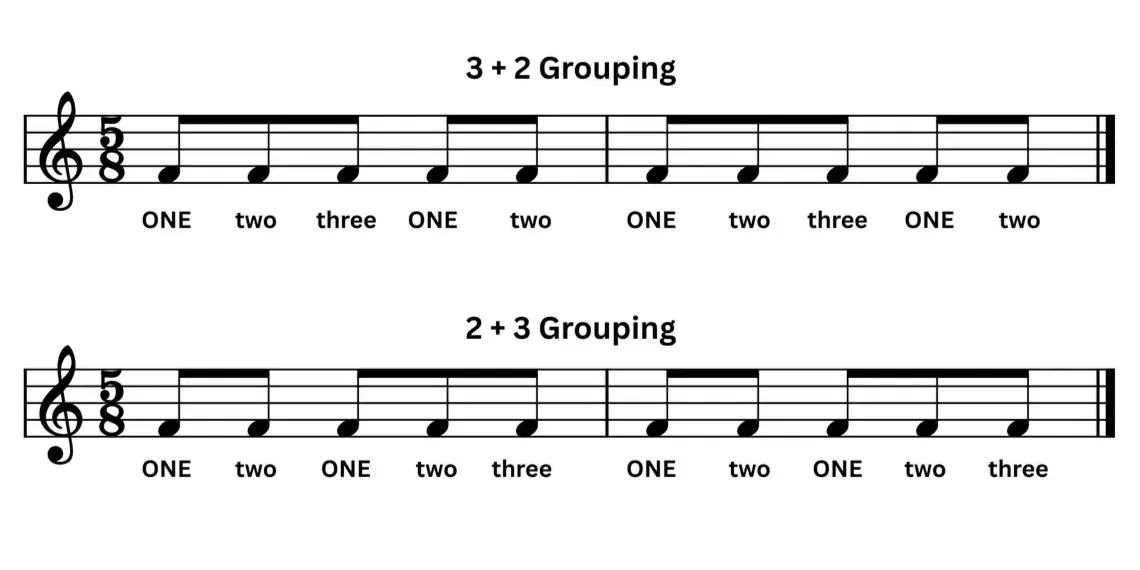
3+2 grouping
Think: ONE-two-three ONE-two
Accents usually land on:
- 1 (start of the bar)
4 (start of the “2” group)
- Count (syllables) — ONE-two-three ONE-two
- Count (numbers) —
1-2-3 1-2
2+3 grouping
Think: ONE-two ONE-two-three
Accents usually land on:
- 1 (start of the bar)
3 (start of the “3” group)
- Count (syllables) — ONE-two ONE-two-three
- Count (numbers) —
1-2 1-2-3
If you drift, simplify the task: keep the grouping and clap only the group starts until it feels stable again.
Why is 5/8 called an odd (asymmetric) meter?
You’ll see 5/8 described as an odd time signature, irregular meter, or asymmetric meter. They’re all pointing to the same practical idea: the bar is usually built by adding a group of 2 and a group of 3 (either 3+2 or 2+3), so the pulses aren’t all the same length.
Another way to say it is that 5/8 often contains one simple beat (2 eighths) and one compound beat (3 eighths). That short + long (or long + short) shape is exactly what you’re trying to hear and count.
Practice 5/8 with a metronome
Open the 5/8 metronome and choose an accent option for 3+2 or 2+3.
Exercise 1: clap only the group starts
Pick one grouping first and stay with it.
- Set the metronome to 5/8.
- Choose an accent option for 3+2 (or 2+3).
- Clap only on the accented clicks (the group starts):
- for 3+2, clap on 1 and 4
- for 2+3, clap on 1 and 3
- Do this for 60 seconds without drifting.
This is the fastest way to stop 5/8 from feeling like five unrelated clicks.
Exercise 2: clap the accents, speak one syllable per click
This is the same idea as Exercise 1, but you add the “small pulse” back in by speaking.
- Keep the same metronome setting (same grouping, same tempo).
- On every click, say one syllable of the count (don't speed up):
- 3+2: say ONE / two / three / ONE / two
- 2+3: say ONE / two / ONE / two / three
- At the same time, clap only on the accented clicks (the group starts).
If that’s too much at first, do it in two passes: say the syllables without clapping for 20 seconds, then add the claps.
Exercise 3: practice the pattern from your song
If your piece stays in one grouping, your practice should match that.
- Keep the metronome on your song’s grouping (3+2 or 2+3).
- First pass: play or tap only on the accented clicks (group starts).
- Second pass: add the remaining notes, but keep the group starts clearly felt.
Common mistakes
- Counting straight to five — Switch to grouping and feel the bar as 3+2 or 2+3.
- Losing the group starts — Strip it back and clap only on the accents for 30–60 seconds.
- Rushing the short group — Slow the tempo down and make the “2” group feel just as wide as it should.
- Not sure which grouping it is — Look at the beaming/accent pattern in notation, or listen for where the phrase leans.
FAQ
What is the difference between 5/4 and 5/8 time?
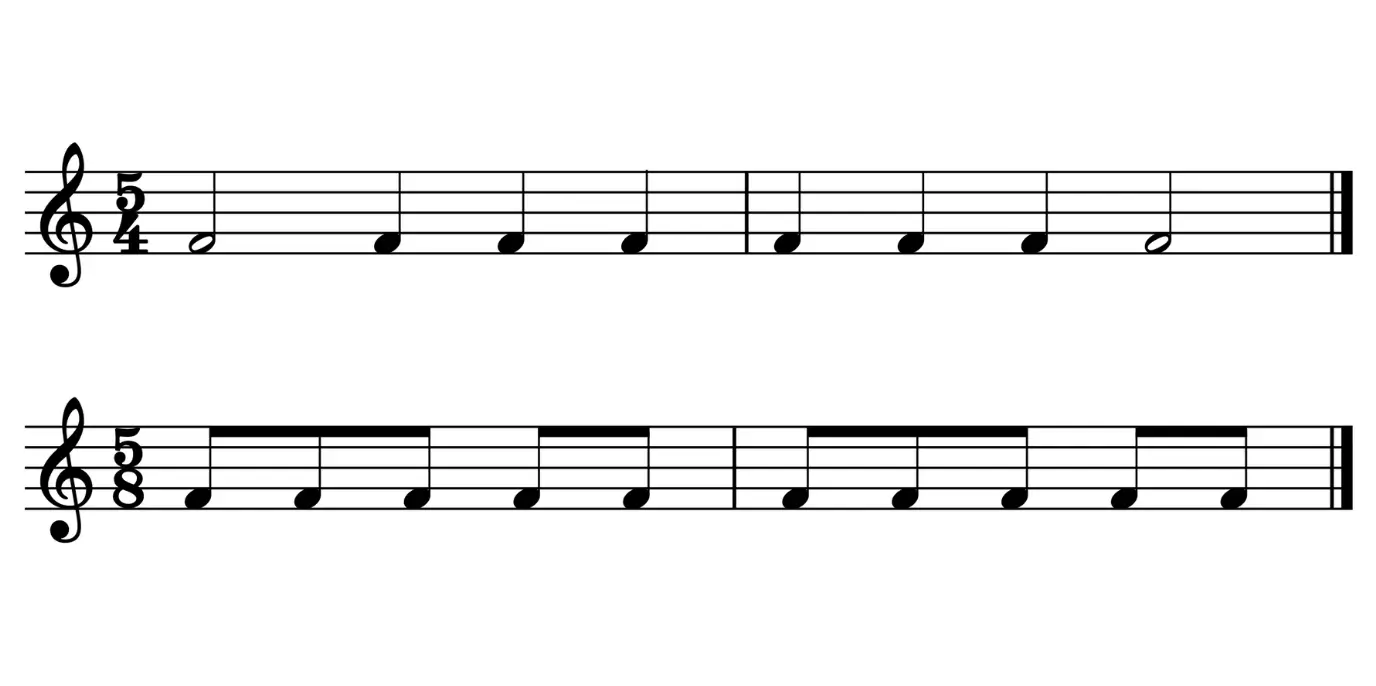
Both have five beats per bar, but the bottom number changes the beat unit:
- 5/4 — a quarter note is the beat unit
- 5/8 — an eighth note is the beat unit
With a metronome, that means the same BPM number produces clicks twice as often in 5/8 if you’re clicking the written beat unit.
Is 5/8 time simple or compound?
Most of the time, 5/8 isn’t treated as purely simple or purely compound. It’s commonly taught as an odd/irregular meter because the bar mixes a group of 2 (a simple beat) and a group of 3 (a compound beat), usually as 3+2 or 2+3.